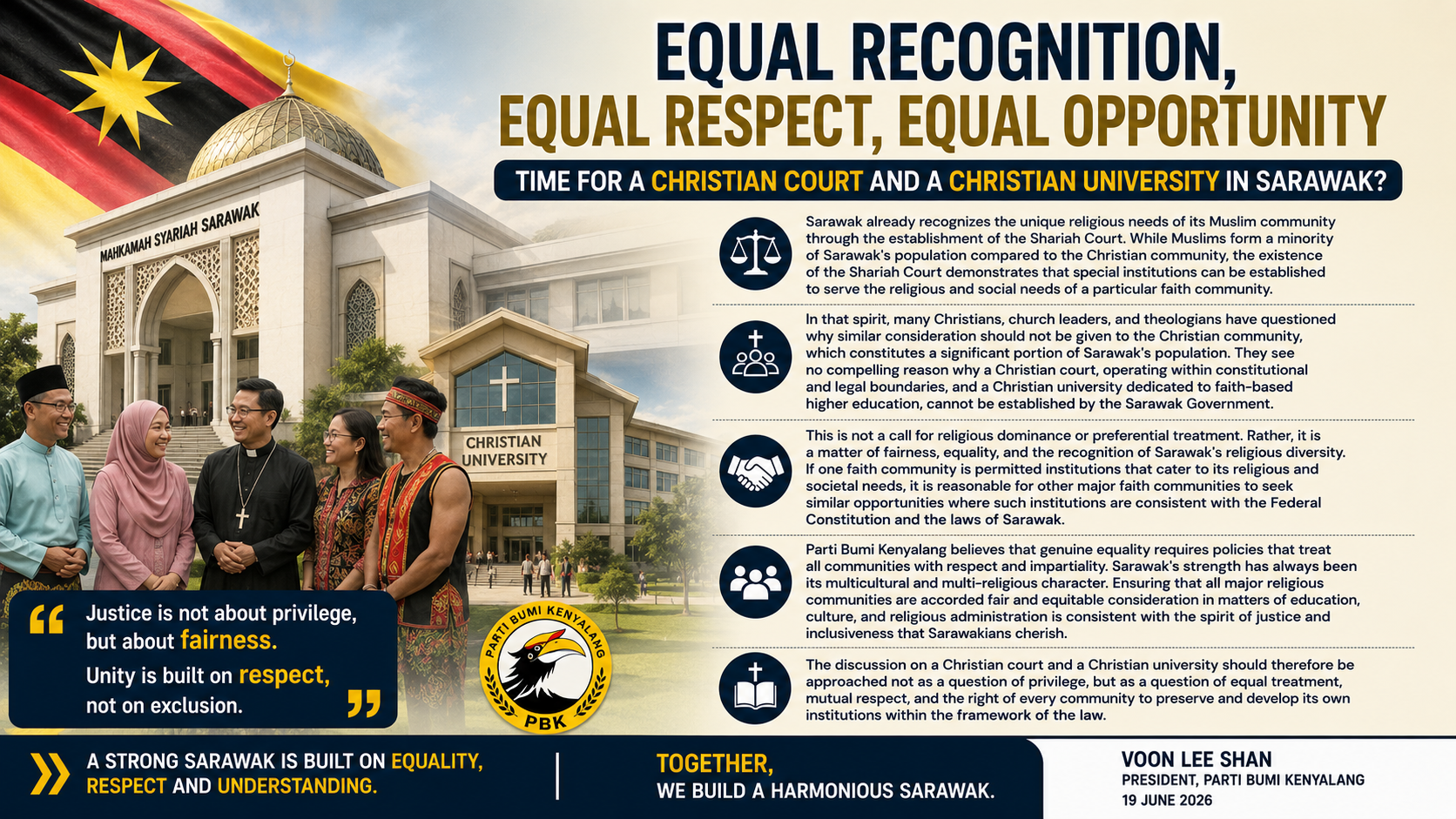
Sarawak already recognizes the unique religious needs of its Muslim community through the establishment of the Shariah Court. While Muslims form a minority of Sarawak's population compared to the Christian community, the existence of the Shariah Court demonstrates that special institutions can be established to serve the religious and social needs of a particular faith community.
In that spirit, many Christians, church leaders, and theologians have questioned why similar consideration should not be given to the Christian community, which constitutes a significant portion of Sarawak's population. They see no compelling reason why a Christian court, operating within constitutional and legal boundaries, and a Christian university dedicated to faith-based higher education, cannot be established by the Sarawak Government.
This is not a call for religious dominance or preferential treatment. Rather, it is a matter of fairness, equality, and the recognition of Sarawak's religious diversity. If one faith community is permitted institutions that cater to its religious and societal needs, it is reasonable for other major faith communities to seek similar opportunities where such institutions are consistent with the Federal Constitution and the laws of Sarawak.
Parti Bumi Kenyalang believes that genuine equality requires policies that treat all communities with respect and impartiality. Sarawak's strength has always been its multicultural and multi-religious character. Ensuring that all major religious communities are accorded fair and equitable consideration in matters of education, culture, and religious administration is consistent with the spirit of justice and inclusiveness that Sarawakians cherish.
The discussion on a Christian court and a Christian university should therefore be approached not as a question of privilege, but as a question of equal treatment, mutual respect, and the right of every community to preserve and develop its own institutions within the framework of the law.