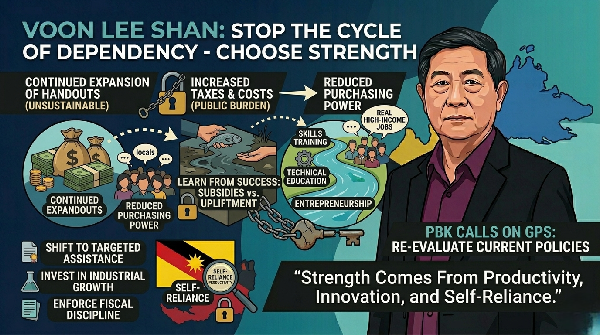
 Sarawak is heading down a dangerous path—and it must be said plainly. The continued expansion of handouts by the Gabungan Parti Sarawak (GPS) government risks creating a culture of dependency that will weaken our economy, burden our people, and mortgage our future.
Handouts are not free. Every ringgit distributed must come from somewhere—either from state revenue, rising taxes, or increased costs passed on to ordinary people. When spending grows without real economic expansion, the rakyat ultimately pays the price through more expensive goods, higher fees, and reduced purchasing power. Giving with one hand while taking with another is not leadership—it is unsustainable governance.
Around the world, the warning signs are clear. Venezuela relied heavily on subsidies and state spending without building a resilient economy, and it collapsed into hyperinflation and widespread poverty. Sri Lanka pursued populist policies and unsustainable subsidies, only to face a devastating economic crisis that left its people struggling for basic necessities. Even Greece, burdened by excessive public spending and weak fiscal discipline, suffered years of hardship under a crushing debt crisis.
These are not distant stories—they are clear lessons. Economies do not fail overnight; they erode when governments choose short-term popularity over long-term strength.
Sarawak must reject this path. A government that truly believes in its people does not keep them dependent—it empowers them. The principle is simple and timeless: do not keep giving fish; teach people how to fish, and ensure there is a thriving river in which to do it.
Parti Bumi Kenyalang calls for an immediate and honest re-evaluation of current policies:
* Shift from blanket handouts to targeted, time-bound assistance
* Invest aggressively in skills training, technical education, and entrepreneurship
* Build industries that create real, high-income jobs for Sarawakians
* Enforce fiscal discipline to prevent future tax burdens on the people
Sarawak has the resources, talent, and potential to stand strong on its own. But that strength will not come from continuous handouts—it will come from productivity, innovation, and self-reliance.
Sarawak has to learn from, Singapore and also from China on how to uplift her people from poverty within four decades.
*If we continue to normalise dependency today, we risk condemning future generations to higher costs, fewer opportunities, and a weaker economy. Sarawak deserves better. The time to change course is now.*