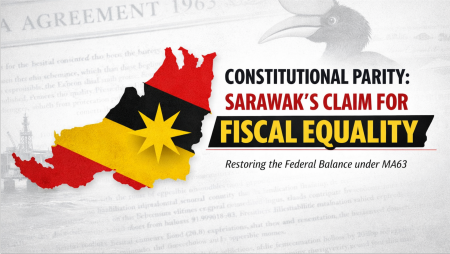
Today, Parti Bumi Kenyalang speaks not merely as a political party, but as a constitutional conscience for Sarawak. We address a question that goes to the heart of Malaysia’s foundation. If Sabah, as a founding territory of Malaysia, is entitled to 40% of the net revenue derived from it by the Federation, can Sarawak — an equal founding partner — be treated differently?
This is not a question of rivalry with Sabah. It is a question of parity, principle, and constitutional fidelity.
Malaysia was created in 1963 pursuant to the Malaysia Agreement signed. Be it known, without Sarawak there could not be a federation of Malaysia. In constitutional law, when political entities come together to form a federation, they do so as partners and all partners should be treated equally. If Sabah is entitled to 40% of revenues collected by federal coffers, there is no reason for Sarawak to be treated differently in the federation. What Sabah gets, Sarawak also should get. Further, anything less transforms partnership into hierarchy or colonialism.
Sabah and Sarawak stood in identical positions in 1963. Both were Borneo territories and both negotiated safeguards. Both entered Malaysia on the basis of autonomy assurances.
If one founding territory receives structural fiscal protection, and the other does not, constitutional equity is offended. The law is not merely text. It is principle. And equity demands parity.
Malaya or the federal government should know a true federation is built upon mutual respect, balanced power and structural fairness. If the federal government which is controlled by Malaya, drifts from the federation into domination, Sarawak should consider her position in the federation. If mistreated, Sarawak’s only recourse should be to seek exit by peaceful means from the federation like what Singapore did in 1965.
The federal government must know that federalism is part of Malaysia’s basic structure where founding territories are all of equal status.
If Sabah’s 40% entitlement is recognised as constitutionally entrenched, then denying Sarawak equivalent structural treatment creates arbitrary inequality and discrimination between co-founders of the nation. Such inequality distorts the federal balance envisioned in 1963.
Sarawak is not asking for privilege but, Sarawak is asserting constitutional symmetry.
The federal government should understand, a federation survives not merely on law, but on trust.
Sarawak contributes significantly to national wealth, particularly through petroleum and natural resources. Yet development disparities remain stark in many rural regions of our State.
Political morality demands that revenue extraction be matched with fair return.
A government that takes disproportionately while returning inadequately weakens democratic legitimacy.
As Abraham Lincoln reminded the world, government must be “of the people, by the people, for the people.” Therefore, Sarawak’s people must feel that the Federation works for them — not over them.
Malaysia was presented internationally as an act of self-determination and partnership — not absorption and subordination.
If Sabah’s 40% formula reflects recognition of its founding status, then justice requires that Sarawak be accorded no less favourable fiscal treatment.
Parity is not extremism, parity is fairness and parity is constitutional fidelity.
Parti Bumi Kenyalang therefore calls for a full constitutional review of Sarawak’s fiscal entitlements under the Malaysia Agreement 1963 framework. Parti Bumi Kenyalang also calls for recognition that Sarawak, as a co-founder of Malaysia, is entitled to fiscal arrangements no less favourable than Sabah. There must also be restoration of the federal balance in accordance with the basic structure of the Constitution.