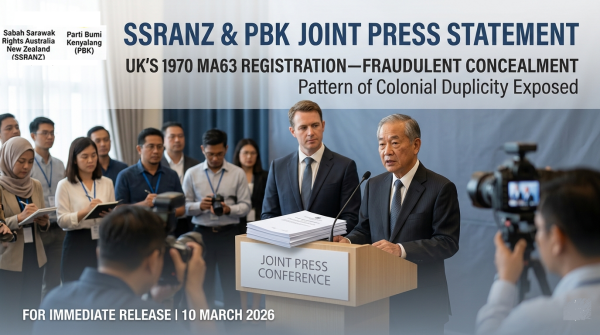
 SSRANZ & PBK: UK'S 1970 MA63 REGISTRATION—FRAUDULENT CONCEALMENT OF SINGAPORE EXIT, UNFULFILLED REFERENDUM OBLIGATIONS, AND SYSTEMATIC BRITISH DECEIT Pattern of Colonial Duplicity Exposed: From Aden to Borneo; Jakarta Peace Treaty Mandate Never Implemented; UN Assessment Ultra Vires; Triple Fraud Compounds Void Ab Initio Status
INTERNATIONAL — In a joint statement/commentary today, the Sabah Sarawak Rights Australia New Zealand (SSRANZ) and Parti Bumi Kenyalang (PBK) revealed that fresh legal analysis has uncovered a startling irregularity in the United Kingdom’s handling of the Malaysia Agreement 1963, which was registered with the United Nations only in 1970—five years after the treaty framework had effectively become defunct following the independence of Singapore in 1965.
Singapore’s exit destroyed the five-party structure of MA63 and fundamentally altered the object of the treaty, rendering the original agreement legally obsolete. The 1970 registration violated the UN Repertory of Practice under Article 102 of the UN Charter. When Singapore lawfully separated on 9 August 1965—becoming an independent sovereign state under UNTS Registration I-8206—MA63 underwent a fundamental change in parties and object.
Singapore's exit in 1965 constituted a fundamental change of circumstances under VCLT Article 62 that destroyed MA63's object — a 4-state federation. The UK was required under UN Regulations to register a modified treaty with a certified statement noting Singapore's exit; register a new 4-party agreement; or provide annotated registration referencing UNTS I-8206.
This exposes systematic British duplicitous conduct spanning three decades: the fraudulent 1970 registration of the Malaysia Agreement 1963 (MA63) did not disclose Singapore's 1965 independence and material change to the federation; the unfulfilled 1966 Jakarta Peace Treaty referendum obligation for Borneo peoples; the ultra vires UN assessment of 1963 conducted while MA63 was unregistered and procedurally unenforceable; and a pattern of colonial duplicity that transferred territories against their peoples' will while prioritizing British geopolitical expedience over genuine self-determination.
The UK chose none of these lawful options, instead perpetrating what amounted to fraudulent concealment to obtain UN legitimacy for a void instrument. This deliberate omission—registering the original 5-party treaty five years after Singapore's exit (and seven years after MA63 was signed) —constitutes bad faith misrepresentation to the United Nations and fraudulent concealment of material change under the Vienna Convention on the Law of Treaties.
The UN Repertory of Practice under Article 102 of the UN Charter explicitly mandates that when a treaty has been registered with the Secretariat, a certified statement regarding any subsequent action which effects a change in the parties thereto, or the terms, scope or application thereof, shall also be registered with the Secretariat. The UK failed to comply with this mandatory requirement for changes in parties.
Furthermore, under VCLT Article 26, every treaty in force is binding upon the parties to it and must be performed by them in good faith, yet the UK perpetrated a bad faith violation by knowingly registering a defunct treaty.
The UK also failed to cross-reference UNTS I-8206, the Singapore Independence Agreement 1965 which was registered separately. Finally, under VCLT Articles 39-41, treaty modification requires agreement and notification, yet there was no Borneo consultation on Singapore's exit—demonstrating
the compounded illegality of the UK's actions.
This verification confirms that the UK's 1970 registration was not merely "late" but procedurally fraudulent under established UN practice, constituting a material misrepresentation to the international community.
PART I: THE ULTRA VIRES UN ASSESSMENT OF 1963—INVOCATION OF AN UNREGISTERED TREATY
The UN assessment, endorsement, and Legal Opinion of 19 September 1963 were all ultra vires Article 102(2) of the UN Charter.
At the time these actions were taken, MA63 was not registered and remained procedurally unenforceable before any UN organ. Article 102(2) explicitly states that no party to any treaty or international agreement which has not been registered in accordance with the provisions of paragraph 1 of this Article may invoke that treaty or agreement before any organ of the United Nations. Yet the UN Secretariat relied on this unregistered and therefore legally non-existent agreement to authorize the 1963 UN Assessment Mission and to issue its Legal Opinion of 19 September 1963—actions that
were ultra vires and in violation of the UN's own Charter.
Critically, MA63 was superseded by the Manila Accord's conditions on Malaysia's formation. The Manila Accord was signed on 31 July 1963 by the Federation of Malaya, the Philippines, and Indonesia, and was registered with the United Nations on 30 December 1965 under UNTS Registration No. 8029—the same year as the Singapore Independence Agreement. This registered instrument established mandatory preconditions for Malaysia's formation that were never fulfilled: a United Nations-supervised and genuinely free ascertainment of the peoples' wishes in accordance with UN General Assembly Resolution 1541 (XV), and a peaceful settlement of the Philippines' territorial claim over Sabah.
The UN assessment of August-September 1963 was conducted while MA63 was procedurally unenforceable under Article 102(2). The parties lacked capacity to invoke MA63 before the UN, and the process was compromised by UK-Malayan collusion with mission members hand-picked to produce the right results as revealed in declassified documents. The UK and Malaya announced Malaysia's formation date of 16 September 1963 before the assessment was completed. The process was not a referendum; it involved limited interviews under colonial pressure with no secret ballot and
no genuine self-determination.
Since MA63 was not then registered and was superseded by the Manila Accord's registered conditions on Malaysia's formation, MA63 remained invalid, and Malaysia was not effectively constituted under international law.
PART II: MA63 AS AMENDMENT, NOT CONSTITUTIVE TREATY—THE FRAUDULENT MISREPRESENTATION
MA63 was not a "constitutive treaty" seeking to create a new federation by dissolution of the Malayan Federation and the creation of a new constitution by four parties. Rather, it was an instrument to enlarge the existing Malayan Federation with a name change by amendment to the Malayan Federal Constitution. This was confirmed by the Malayan Permanent Representative Dato Ong Yoke Lin in his letter to the UN Secretary-General on 16 September 1963, which presented Malaysia to the United Nations as merely a change of name from Malaya to Malaysia without expressly mentioning the addition of three new territories—Singapore, Sarawak, and Sabah. This misrepresentation was necessary because the concept of Malaysia was objected to by the Philippines and Indonesia.
The Federal Constitution of Malaysia was not a new constitution but the Constitution of Malaya amended to reflect the terms agreed upon in MA63. The Malaysia Act 1963 passed by the British Parliament and the Federal Constitution (Amendment) Act 1963 incorporated MA63's provisions into
the existing Malayan constitutional framework. This confirms that MA63 was an amending instrument to an existing federation, not a constitutive treaty establishing a new sovereign entity.
The Federation remained "the Federation established under the Federation of Malaya Agreement 1957" until constitutional amendments in 2021 finally recognized MA63 in the definition of "The Federation." This distinction is legally significant: if MA63 was merely an amendment to the Malayan Constitution rather than a new constitutive act, then the absorption of North Borneo and Sarawak was an
enlargement of Malaya's territory without genuine self-determination, not the formation of a new federation of equal partners. The "partnership" language of the Cobbold Commission was legally undermined by the constitutional reality of absorption into an existing state.
PART III: THE 1965-1970 REGISTRATION CONFLICT—FRAUDULENT CONCEALMENT OF MATERIAL CHANGE
The Independence of Singapore Agreement 1965 (registered UNTS I-8206) lawfully terminated Singapore's participation in Malaysia, establishing Singapore as an independent and sovereign state on 9 August 1965. This was a new treaty creating new sovereignty, not an exercise of capacity derived from MA63. Singapore's 1959 internal self-government did not confer treaty-making power for territorial dispositions; that power remained with the UK as administering power until 1965.
Critically, the 1965 Singapore Independence Agreement did not and could not cure MA63's original defects. Under VCLT Articles 39-41, treaty modification requires agreement between all parties and notification. The Singapore Agreement terminated MA63 as regards Singapore; it did not validate MA63's original colonial incapacity regarding North Borneo and Sarawak.
Yet in September 1970, the UK registered MA63 as the original 5-party treaty, listing Singapore as a signatory five years after its lawful separation. This was fraudulent misrepresentation to the UN: the UK knowingly filed a false instrument, concealing that Singapore was no longer a party having been independent since 1965; that Malaysia had been reduced from 4-entity to 3-entity federation; and that Sabah and Sarawak were never consulted on this fundamental modification, violating VCLT Article 41.
The timing is revealing: the UK withdrew the combined Commonwealth forces from Borneo only after Pax Malaysia was secured through military suppression from 1963 to 1966, the Jakarta Peace Treaty ended Indonesian opposition in August 1966, and Malayan control was irreversible. The 1970 registration provided retrospective veneer of legitimacy for an accomplished colonial transfer.
Significantly, in 1971 the Five Powers Defence Arrangement (FPDA) was formed, putting the seal to secure Pax Malaysia. Under the UN Repertory of Practice, the UK was required to register a modified treaty with certified statement noting Singapore's exit, register a new 4-party agreement, or provide annotated registration referencing UNTS I-8206. The UK chose none of these lawful options, instead perpetrating fraudulent
concealment to obtain UN legitimacy for a void instrument.
PART IV: PATTERN OF BRITISH DECEIT—FROM ADEN TO BORNEO
This fraud fits a systematic pattern of British decolonization duplicity. In Aden in 1967, Britain promised independence in 1968 with a federal government established through the South Arabian Federation, yet recognized the terrorist National Liberation Front to expedite withdrawal and abandoned the federal government to chaos. The parallel to Borneo is stark: Britain promised "self-determination" to Borneo but transferred the territories to Malaya instead of granting independence.
In Kenya in 1963, Britain promised gradual African self-rule but hastened withdrawal due to the Mau Mau uprising, resulting in Jomo Kenyatta being "elected" without full preparation. The Borneo parallel shows Britain hastening Malaysia in 1963 to counter "Konfrontasi" without holding genuine
Borneo elections.
In Egypt in 1956, Britain promised honorable withdrawal from Suez but engaged in the secret Protocol of Sèvres and deception of allies. The Borneo parallel reveals the secret 31 July 1962 UK Malaya Agreement and deception of Borneo peoples.
In Aden in 1967, Britain recognized the NLF as government "to expedite her withdrawal"— abandoning the federal government it had established. In Borneo in 1963, Britain transferred territories to Malaya—abandoning its 1946 undertaking to grant independence. The "little empire" was created not for Borneo welfare, but for British geopolitical convenience and Cold War containment.
PART V: THE JAKARTA PEACE TREATY 1966—UNFULFILLED REFERENDUM OBLIGATION
The Bangkok Accord of 11 August 1966 (formally signed as the Jakarta Peace Treaty 1966) ending Indonesia-Malaysia "Konfrontasi" contained a critical unfulfilled obligation. Article I required Malaysia to agree to a reaffirmation by the people of Sabah and Sarawak "in a free and democratic
manner as soon as practicable through general elections" of "their previous decision about their status in Malaysia." The UK as the colonial power and main MA63 signatory would have an obligation to insist on this being carried out but it remained silent since 1966.
The US State Department noted that initially Malaysia was given to understand by the Indonesians that the requirement was pro forma. In subsequent negotiations, however, it became clear that the Indonesians had shifted from this position and regarded an actual reascertainment as indispensable.
The referendum was NEVER held. Malaysia expected to satisfy the requirement by a question on the ballot at the next regular election, but there was serious doubt that electoral districts could be delineated. Kuala Lumpur would not want that administration tested in an early election.
Indeed, the then (replacement) Chief Minister of Sarawak, Tawi Sli, announced he would not allow such a question to be put on the ballot in his state.
This was a material breach of international peace treaty obligations. The UK, having secured Indonesian recognition of Malaysia through this promise, allowed Malaysia to evade its implementation—further evidence that British decolonization prioritized geopolitical expediency over genuine self-determination.
PART VI: TRIPLE COLONIAL FRAUD—1946, 1963, 1970
The compounding illegality of MA63 spans three decades. In 1946, the UK annexed Sarawak and Sabah with an undertaking to grant independence but suppressed the anti-cession movement. This represents the original sin—void acquisition of title and breach of trust.
In 1963, the UK transferred territories to Malaya despite the 1946 undertaking, held no referendum, imposed coercive conditions, and rigged the UN assessment. This constitutes ultra vires transfer with no valid consent and breach of Manila Accord conditions.
In 1970, the UK registered MA63 concealing Singapore's exit, material change, and the unfulfilled referendum obligation. This constitutes fraudulent misrepresentation to the UN and bad faith under VCLT Article 26.
The Manila Accord of 31 July 1963 explicitly made Malaysia formation conditional on UN assessment of people's wishes and resolution of the Philippines claim. Both conditions were breached —the assessment was rigged with the date announced prematurely before completion, and the
Philippines claim remains unresolved.
PART VII: LEGAL IMPLICATIONS—VOID AB INITIO AND BEYOND
MA63 is void ab initio on multiple independent grounds under international law. First, colonial incapacity as established in Chagos 2019 and East Timor 1995. The ICJ in Chagos Advisory Opinion (2019) established: "One cannot talk of an international agreement when one of the parties had been under the authority of the other." North Borneo and Sarawak were Crown Colonies under UK authority in 1963—no referendum was held, and "consent" was manufactured, not genuine.
Second, breach of UN Charter Article 102(2). From 9 July 1963 to 21 September 1970, MA63 was unregistered and procedurally unenforceable before any UN organ. The UN assessment of AugustSeptember 1963 was ultra vires—conducted while the treaty lacked procedural validity.
Third, breach of Manila Accord 1963. The UK and Malaya agreed that Malaysia formation was conditional on genuine UN assessment and Philippines claim resolution. Both conditions were breached—the assessment was compromised by UK-Malayan collusion with mission members handpicked to produce the right results and the premature announcement of the Malaysia proclaimation date (16/09/63) while the UN assessment was still in progress.
Fourth, fraudulent registration 1970. The UK knowingly filed a false instrument with the UN, concealing Singapore's exit, material change to 3-entity federation, and absence of Borneo consent to modification under VCLT Article 41. This demonstrates bad faith under VCLT Article 26.
Fifth, unfulfilled Jakarta Peace Treaty 1966. The referendum and reascertainment obligation was never implemented—constituting material breach of international peace agreement under Bangkok Accord Article I.
Sixth, fundamental change of circumstances under VCLT Article 62. Singapore's 1965 exit destroyed MA63's object—a 5-state federation. Sabah and Sarawak and apparently the United Kingdom were never consulted on this modification.
CONCLUSION: RESTITUTIO IN INTEGRUM
The 1970 registration—far from validating MA63—exposes systematic colonial fraud spanning three decades: fraudulent acquisition in 1946, fraudulent transfer in 1963, and fraudulent legitimization in 1970. This fits the British pattern of decolonization duplicity seen in Aden, Kenya, and Suez— prioritizing geopolitical expedience over legal obligation and genuine self-determination.
SSRANZ and PBK demand three immediate actions.
First, a UN investigation of the 1970 registration as fraudulent misrepresentation under UN Charter Article 102.
Second, an ICJ Advisory Opinion on the legal consequences of Singapore's exit for MA63 validity, the unfulfilled Jakarta Peace Treaty referendum obligation, and the UK's pattern of decolonization duplicity.
Third, a UN-supervised referendum for Sabah and Sarawak to finally exercise self-determination, sixty years overdue. The answer to "Was MA63 valid?"—assessed against binding international precedent, British colonial undertakings, Manila Accord conditions, and peace treaty obligations—is no. The chain of illegality commenced in 1946 with fraudulent annexation and breached undertakings, voided MA63 ab initio in 1963, was compounded by fraudulent registration in 1970, and remains void today.
Signed:
Voon Lee Shan President Parti Bumi Kenyalang (PBK)
Robert Pei President Sabah Sarawak Rights Australia New Zealand (SSRANZ)
Date: 8 March 2026
#manus #gemini #chatgpt #Sibu #Sarawak #yuchinliik #hospital #GPS #MA63 #pda74 #TSA2012 #PBK