If prison can now have an address change—shifting from a prison cell to a private residence—we must ask ourselves what message this sends to ordinary Malaysians.
It must be said with sobering sarcasm: perhaps one day we will no longer need to build more prisons. We will simply provide a comfortable house, put the necessary conditions in place, and call it “home detention.”
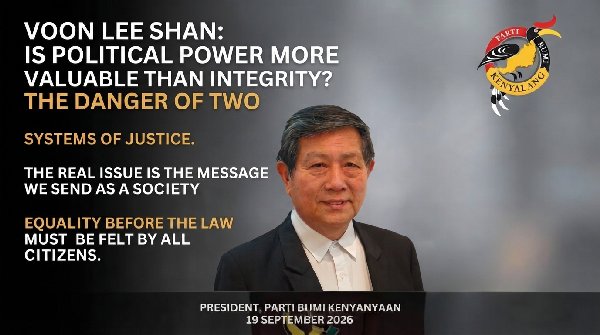
However, the real issue is not merely the physical walls surrounding a prisoner. The real issue is the message we project as a society.
When people celebrate, defend, or revere politicians convicted of serious wrongdoing, they may feel content today. But what precedent are we setting for the leaders of tomorrow?
-
Are we telling them that political power comes with special privileges?
-
Are we teaching our youth that political influence is far more valuable than integrity?
-
Does society unintentionally encourage the notion that the greater one's political territory, the more untouchable one becomes?
Once that culture takes root, political wrongdoing does not shrink—it expands. Today, it may affect someone else’s domain; tomorrow, it reaches deeper into our public institutions, our economy, our resources, and the future of our children. A country cannot build sustainable peace and prosperity by admiring power without accountability.
The Threat of Two Classes of Justice
Ordinary prisoners and the less fortunate do not enjoy access to such arrangements. They serve their full sentences behind cold prison walls, while select figures enjoy conditional comfort at home.
This creates a dangerous public perception: two separate legal systems and two distinct classes of citizens—one for ordinary people, and another for those who once wielded political power. That perception alone deals a heavy blow to the dignity of justice and public confidence in democracy.
Equality before the law must be felt and seen by ordinary citizens, especially those without political influence, powerful connections, or public platforms.
A Call to Safeguard Sarawak’s Future
This statement is not about denying anyone their legal or constitutional rights. It is about a fundamental question for our nation's conscience:
“What kind of political culture are we creating when those who hold or once held great political power receive treatment ordinary citizens will never experience?”
When wrongdoing becomes an ambition and accountability is weakened, political office ceases to be a public trust and becomes a territory to be conquered.
We must never allow our admiration for political personalities to overshadow our respect for justice, integrity, and equality. A society that abandons accountability will eventually discover that political territories have expanded so far that they consume the very institutions meant to protect the people.
That is not the peace, prosperity, or dignity that Malaysians—and the people of Sarawak—deserve.
Voon Lee Shan
President, Parti Bumi Kenyalang (PBK)
19 September 2026